
🌈 Early Childhood Math Olympiad Classes | The Ideal Stepping Stone from Math Enlightenment to Math Olympiad Prodigy | At What Age Should You Start Learning Math Olympiad? Start at age 4 to build number sense and cultivate logic and problem-solving skills.
Updated: 05/03/2026
Many parents ask:
❓ At what age is it best to start learning Olympiad math? ❓ Is Olympiad math good for children? Is it too difficult? ❓ Should young children learn regular math or Olympiad math first?
In fact, Olympiad math is not simply about "solving difficult problems," but rather a learning method that trains logical thinking and problem-solving skills. If the method is correct, children will not only not resist it, but will also build mathematical confidence through play.
This article will provide a comprehensive analysis for parents:
- At what age should I start learning math olympiad?
- How to introduce math to young children
- The impact of math olympiad on children's abilities
- The difference between Olympiad math classes and self-study
Parents are overjoyed when their children show interest in math. After completing math game courses like Montessori or Active Math Player, they may have already begun to love numbers and shapes, but jumping straight into formal Olympiad math can be a bit difficult for young children. So what's the next step?
Early childhood math games serve as a "bridge" between math games and English math olympiad. In these courses, children can still use various teaching aids to conduct experiments and play games, while simultaneously developing spatial concepts, logical thinking, and reasoning skills, allowing them to gradually become little math olympiad prodigies in a relaxed environment.
What is CEA?
Early Childhood Math Olympiad Games Course is a bridging course with clear teaching objectives. Its core is not simply "playing games," but rather systematically cultivating children's mathematical thinking foundation through structured activities.
The three pillars of the course
🔹 Concrete Stage: Enhances the real perception of space and quantity through hands-on activities with numerous physical objects.
🔹 Engagement Stage: Maintain focus and learning motivation through highly interactive group games.
🔹 Abstract Transition: Gradually transitioning from operational skills to mental arithmetic and abstract reasoning.
Systematically cultivate four core mathematical abilities
A well-designed early childhood math olympiad game curriculum can generally improve the following four key aspects simultaneously:
- ✔️ Mathematical application ability
- ✔️ Spatial and graphic concepts
- ✔️ Logical reasoning ability
- ✔️ Ability to observe and analyze patterns
These four abilities form the foundational framework connecting English Mathematical Olympiad with international mathematics competitions.
🎯 Examples of Olympiad Math Game Problems (Applicable to Different Abilities)
Level 3 Book 1 | Understanding Graphical Structures
A hexagon can be composed of 6 triangles. 👉 Key point: Developing the ability to decompose shapes and understand the part-whole concept.
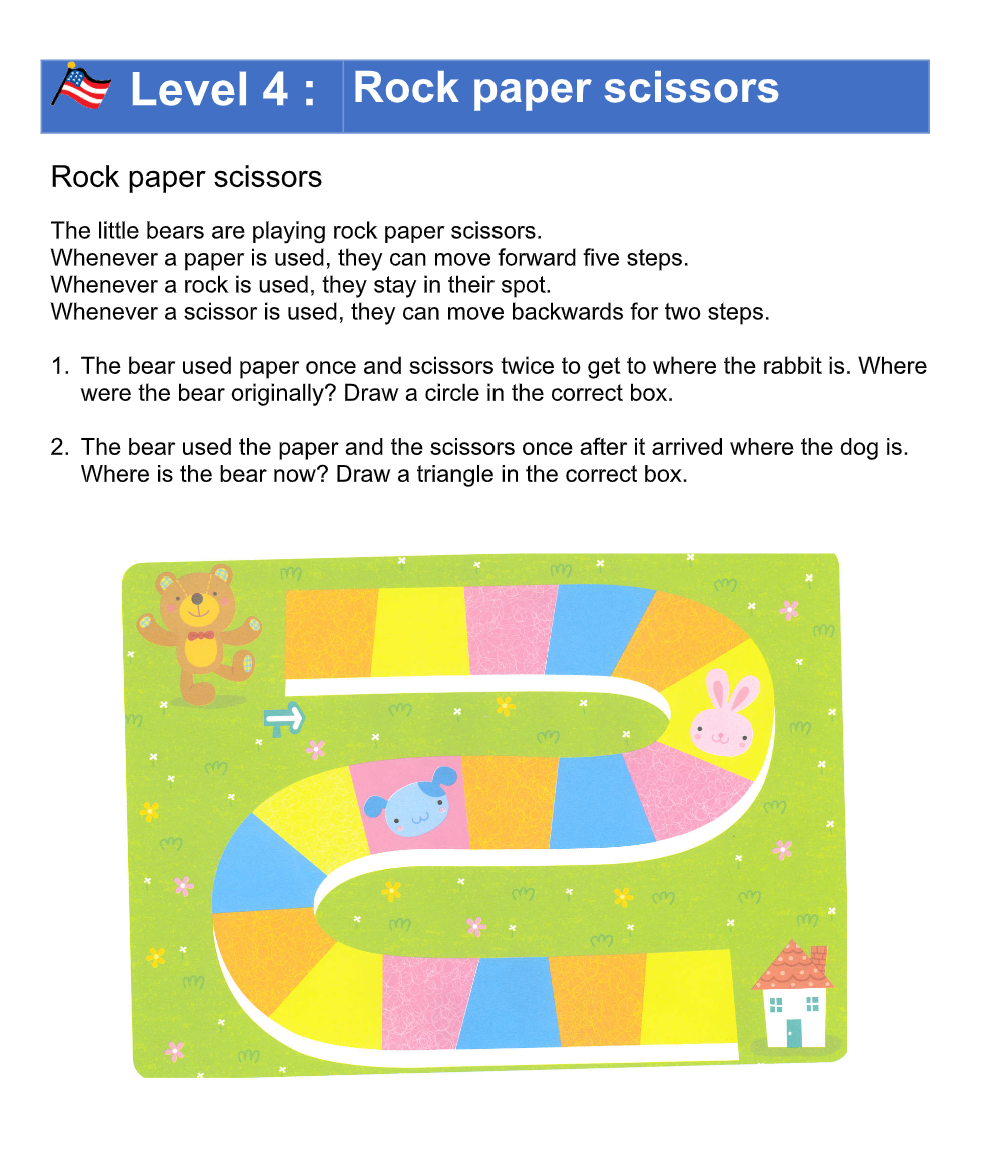
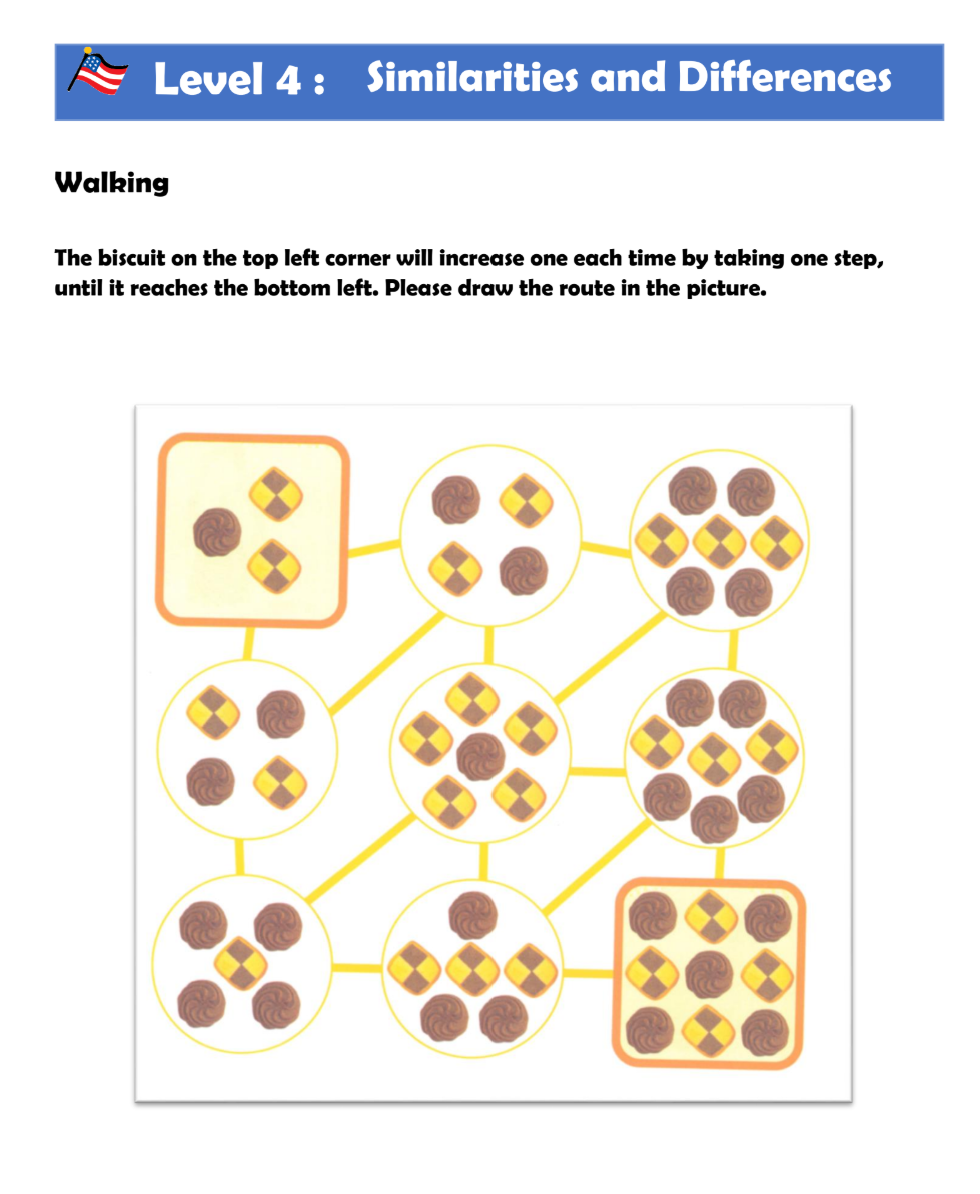
Level 4 Book 1 | Pattern Observation Skills
Observe the change. Students need to identify the increasing path through careful observation.
👉 Key point: Develop early pattern sense.
Level 5 Book 3 | Understanding Spatial Turning
It is difficult to accurately determine the direction of reversal by relying solely on mnemonic rhymes; practical operation is necessary.
👉 Key to teaching: Hands-on experience takes precedence over rote memorization.
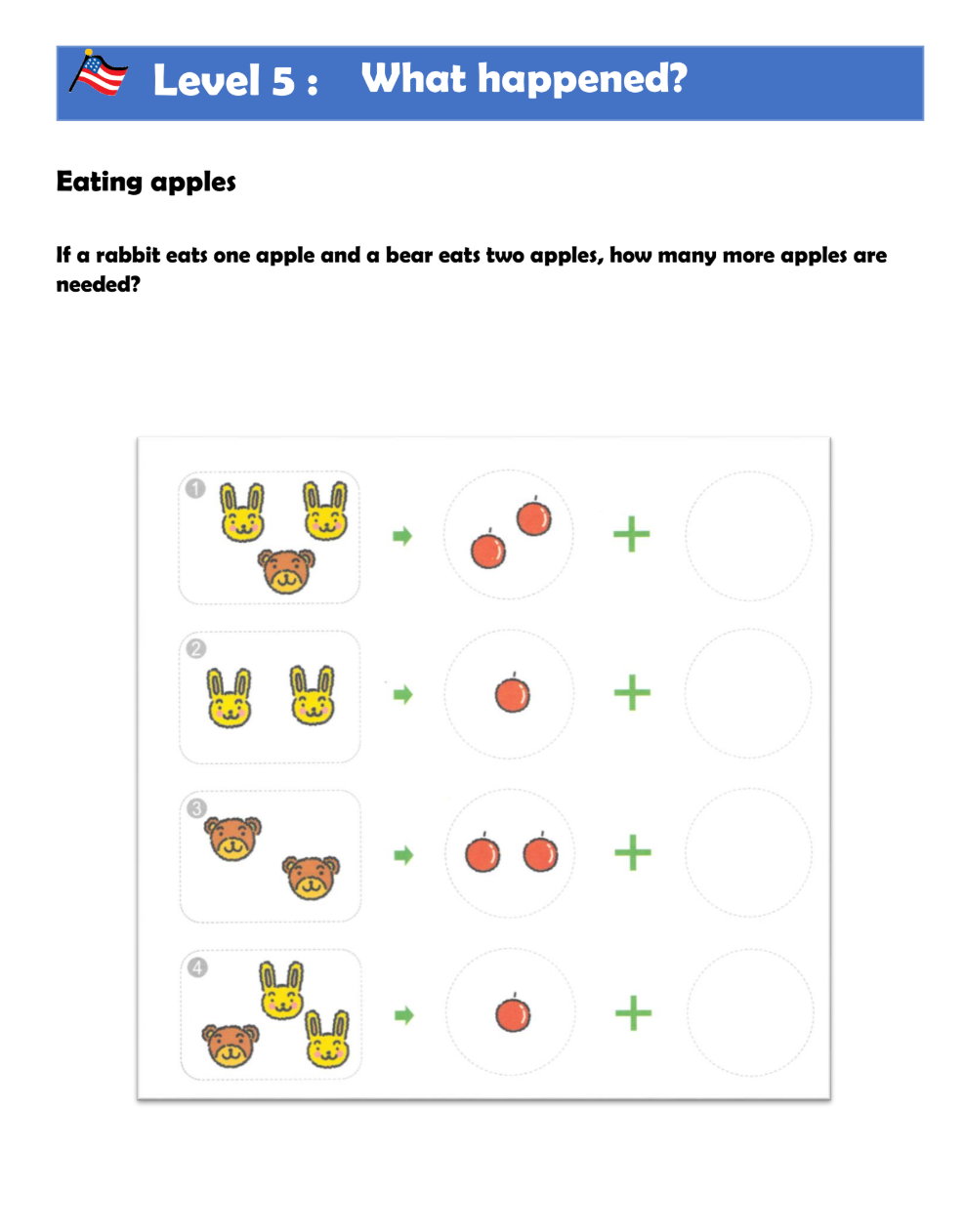
Level 5 Book 6 | Elementary Algebraic Thinking
The relationship between the number of apples for the rabbit and the bear cub.
👉 Key point: Shift from specific quantities to relational thinking (pre-algebra).
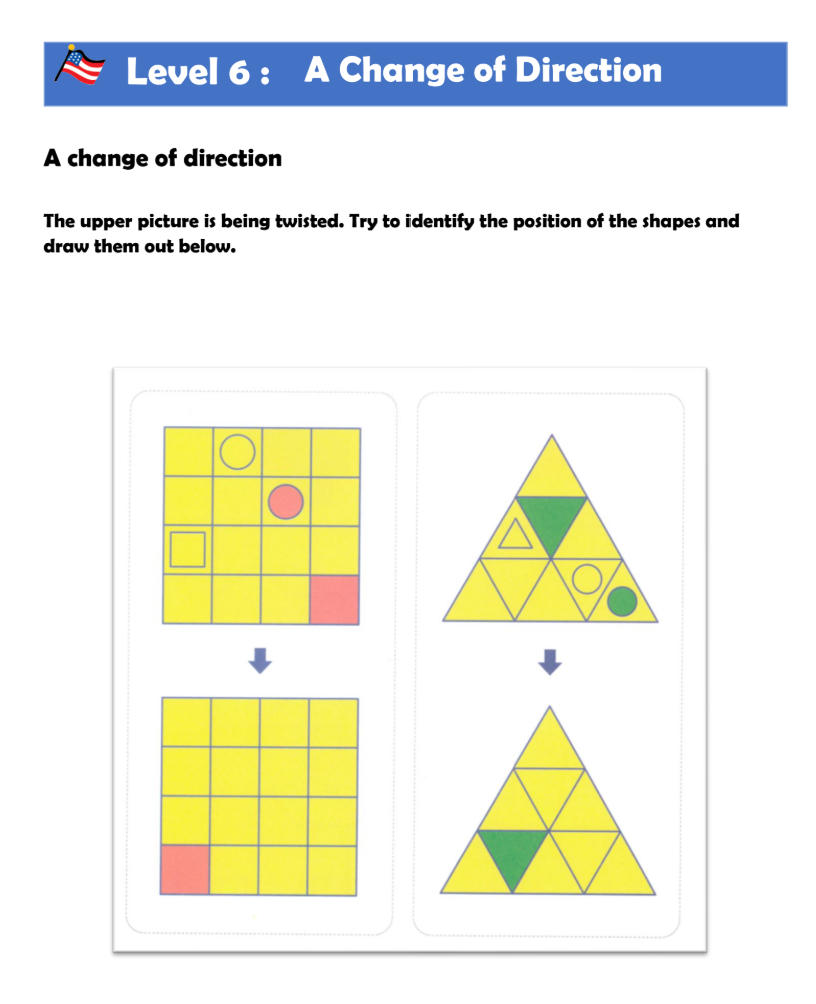
Level 6 Book 4 | Coordinate and Mirror Reasoning
The position of a 4x4 table after being flipped horizontally.
👉 Key point: Cultivate high-order spatial mapping ability (core preparation for Olympiad mathematics).
🏆 Ultimate Comparison Chart of the Three Courses (PSM vs OMP vs AMP)
| Course Types | Best age | Learning Focus | Which type of child is it suitable for? |
|---|---|---|---|
| English Math Olympiad (PSM) | 6 years and older | 48 kinds of math Olympiad tools | Competition or high motivation |
| Olympiad Math for Young Children (OMP) | 4 years and older | Spatial reasoning, word problems | Gifted or Interview Preparation |
| Math Games Program (AMP) | 3–6 years old | Number sense understanding and cultivating interest | Most children |
💡 Course Highlights:
- Interactive games: group activities and team challenges make learning math fun for kids.
- Mathematical Applications: Understanding Mathematical Concepts Through Real-Life Examples
- Logic and Reasoning: Training Analytical Skills and Thinking Strategies
- Space and Observation: Exploring Patterns in Shapes, Colors, and Arrangements
🏁 Frequently Asked Questions from Parents: When to switch to English-language math olympiad?
Based on actual teaching observations, most students meet the following conditions:
- Focus and stability during class
- Able to complete basic homework
- Continue learning for approximately 3 months
It has effectively filled the knowledge gap between "mathematical games → Olympiad math thinking".
🎉 Recommended pathway (professional path)
🚀Most students will adopt one of the following advanced strategies in the fourth month:
Mode A | Directly connects to English Math Olympiad
- Suitable for students with mature comprehension and concentration skills.
Mode B | Dual-track parallel operation (interspersed with plum blossoms and bamboo)
- 1 Early Childhood Math Olympiad Game Lesson 1 English Math Olympiad Lesson
👉 This model is a highly successful transition solution in educational practice.

📌Professional advice: Assess first, then plan.
Every child's number sense maturity, spatial ability, and attention patterns differ. Rather than relying solely on age, it is recommended to first conduct a professional assessment using a Diagnostic Test.
Through evaluation, it can be:
- Accurately locate the child's math stage
- Identify potential gaps in understanding
- Develop personalized connection strategies
This is more educationally effective than blindly starting or delaying learning.
🎯 Summary
Early childhood math games are not just optional transitional classes, but rather a strategically valuable bridging layer in the modern mathematics learning path.
Only when children's interests and abilities are properly balanced can they truly begin their mathematical education and steadily progress towards becoming math olympiad prodigies.
🧠 At what age should I start learning advanced math?
Generally speaking:
📊 English math olympiad courses are best started for children aged 4–6.
The reason is that children of this age:
- I have begun to understand basic quantity concepts.
- Able to perform simple logical reasoning
- Highly engaged in gamified learning
If a child is under 6 years old but has outstanding math skills, a Diagnostic Test can be taken first to determine which course they should start with.
1️⃣ Math Olympiad Game Course 2️⃣ English Math Olympiad Course
By starting with the right things, children can more easily build a sense of accomplishment and develop an interest in learning.
👶 At what age should children start learning math?
Many parents confuse "abacus" with "mental arithmetic," but the two are actually quite different: children as young as 3 can begin to be exposed to mathematical concepts.
But the key point is not calculation, but establishment:
✨Number Sense
For example, through:
🎲 Math Games 🧩 Jigsaw Puzzles 🔢 Quantity Comparison 🧸 Manipulating Teaching Aids
Many overseas education systems, such as the Montessori method, use teaching aids to help children understand mathematical concepts, rather than simply doing problems.
Parents should avoid a common problem:
❌ Avoid early "Hong Kong-style rote learning"
This method often only trains:
- Calculation speed
- Memorizing formulas
However, it may not necessarily develop a true understanding of mathematics.
Once children develop a sense of numbers, it will be easier for them to begin Olympiad math training.
🚀 Is it good for kids to learn advanced math?
Many parents are worried:
"Is the International Mathematical Olympiad too difficult?"
In fact, what the International Mathematical Olympiad (IMO) really trains is not difficulty, but a way of thinking.
Through math olympiad, children can develop:
🧠 Logical reasoning ability 🔍 Problem analysis ability 🎯 Strategic thinking ability 💪 Resilience and problem-solving ability
At the same time, math olympiads also help children develop the following important abilities:
- Patience and focus
- Emotional control
- Solving problems independently
- Adversity training
- Frustration education
These skills will be of great help in future college entrance interviews and learning.
📊 How should I choose an Olympiad math course?
When choosing an Olympiad math course, parents are advised to pay attention to one important factor:
📚 Does the course have a tiered system?
The ideal learning path for Olympiad math should be:
Math games
↓
Olympiad Math Game Course
↓
English Math Olympiad
↓
Math Olympiad Training
This way, children can progress gradually and won't lose confidence due to sudden increases in difficulty.
In addition to the curriculum at the education center, parents can also supplement their children's education with some overseas teaching materials, such as:
📖 Beast Academy
These types of teaching materials typically include:
- Complete course structure
- Systematic thinking training
- Fun comic-style teaching
Therefore, it is highly recommended by many mathematics educators.
🎲 Early Childhood Math Interest Class
The focus of early childhood mathematics learning should be:
Learn math through games
For example:
🎲 PLAY WITH NUMBERS 🧩 Math Logic Game 👫 Group Interactive Activity
Through activity-based teaching, children can not only:
- Establishing mathematical concepts
- Improve expression skills
- Enhance social confidence
It can also avoid the stress caused by mechanical drills.
🏆 Recommended Olympiad Math Classes
An ideal math olympiad course should have the following characteristics:
✔ Systematic teaching materials ✔ Gradually increasing difficulty ✔ Heuristic teaching ✔ Logical thinking training
Through math Olympiad-style problems, students can gradually improve their skills:
- Analytical ability
- Deductive reasoning ability
- Problem-solving skills
These abilities are not only required for competitions, but also an important foundation for future learning.
📖 Can I learn Olympiad math on my own?
In theory, Olympiad math can be learned on one's own, but some challenges will be encountered.
Because Olympiad math problems usually:
- There is no fixed solution method
- Different approaches need to be explored.
- Emphasis on discussion and reasoning
If it's just:
Do the questions → See the answers
It can easily turn into a simple text-based exercise.
Without guidance and discussion from a tutor, children may find it difficult to truly understand the problem-solving approach.
Therefore, many parents choose:
📚 Course Self-study materials
Dual-track learning.
❓ Frequently Asked Questions (Q&A) for Parents
At what age is it best to start learning advanced math?
It is generally recommended to introduce Olympiad math concepts to children aged 4–6. If a child is younger but has outstanding mathematical abilities, an ability assessment can be conducted first.
Is the International Mathematical Olympiad (IMO) too difficult?
If the curriculum is designed properly, Olympiad math is actually a game-based logic training, rather than simply solving difficult problems.
What are the differences between Olympiad math and regular math?
Regular mathematics emphasizes calculation skills, while Olympiad mathematics places even greater emphasis on:
- Logical reasoning
- Problem-solving strategies
- Think from multiple perspectives.
Should young children learn math or advanced math first?
It is recommended to first develop number sense and interest in mathematics before gradually moving on to Olympiad math training.
Other articles:
🧠 What is number sense? Why do some children learn math so quickly?
👶📚 Early childhood math is more than just "counting"!
🧠 At what age should parents start learning advanced math? Many parents are actually asking the wrong question.
🧩 Can kindergarteners take on advanced math challenges? Try these K2 & K3 advanced math problems!
🧮 Abacus Mental Arithmetic vs. Olympiad Math vs. Early Childhood Math Courses | The Most Common Mistake Parents Make