Fast-track Addition up to 20 (Primary 1 Interviews): Master carrying with finger addition and tackle preschool math interview questions! 🧮🎓
Published : 07/10/2026
When preparing for Primary One interviews, many parents hope their children can quickly master addition within 20.
For example:
👉 8 + 8 = ?
👉 9 + 6 = ?
👉 7 + 5 = ?
If children can answer quickly, that’s certainly a good thing.
However, when preparing for Primary One interviews, there’s one more thing parents should pay attention to:
« Does your child really understand addition, or have they simply memorised the answers? »
In addition to straightforward addition questions, interviewers may also change the questions slightly to assess a child’s number sense, logic and understanding.
Here’s a simple way to help children grasp the basics of addition within 20.
✋ Step 1: Use both hands to represent 0–10
We can start by turning fingers into a “number tool” that’s easy for children to understand.
One hand can represent 0–10
- 👊 Fist = 10
- ☝️ Index finger = 1
- ✌️ Index finger + middle finger = 2
- 🤟 Index + middle + ring fingers = 3
- 🖐️ Four fingers = 4
- 👍 Thumb = 5
- 👍☝️ Thumb + index finger = 6
- 👍✌️ Thumb + index finger + middle finger = 7
- 👍🤟 Thumb + index finger + middle finger + ring finger = 8
- 🖐️ Five fingers = 9
🧮 How do you work out 8 + 8? (One number + another number | Carrying addition)
For example, if the interviewer asks:
8 + 8 = ?
Children can start by using both hands to show 8.
Left hand: 5 + 3 = 8
Right hand: 5 + 3 = 8
This is where the “make ten” strategy comes in.
How much do you need to add to 8 to make 10?
The answer is 2.
So:
8 + 2 = 10
Subtract 2 from 8 on the left hand, leaving:
8 - 2 = 6
Therefore:
8 + 8
= 10 + 6
= 16
💡 The point of this method isn’t just to help children “work out 16,” but to help them start understanding:
«8 can be split into 2 + 6, and 2 can help make 10 with the other 8.»
This is the important early maths concept of “making ten.”
2. 🔢 How else can you work out 18 + 8? (Two addends + one addend | Carrying addition)
Once children have mastered addition within 20, they can gradually move on to adding a one-digit number to a two-digit number.
For example:
18 + 8 = ?
18 is:
10 + 8
First, we keep “10” in mind.
Then calculate:
8 + 8 = 16
Then add back the 10 they started with:
10 + 16 = 26
So:
18 + 8 = 26
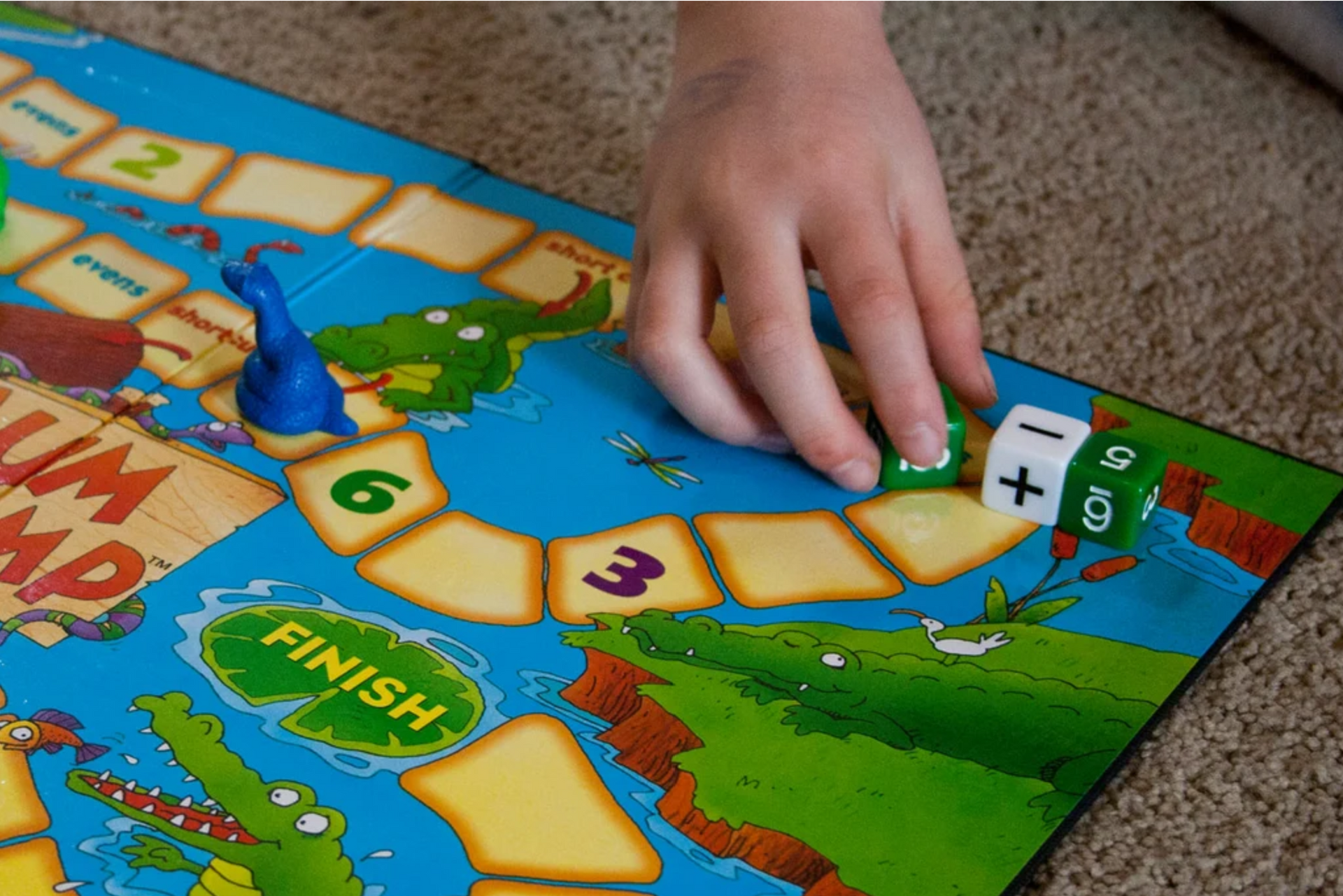
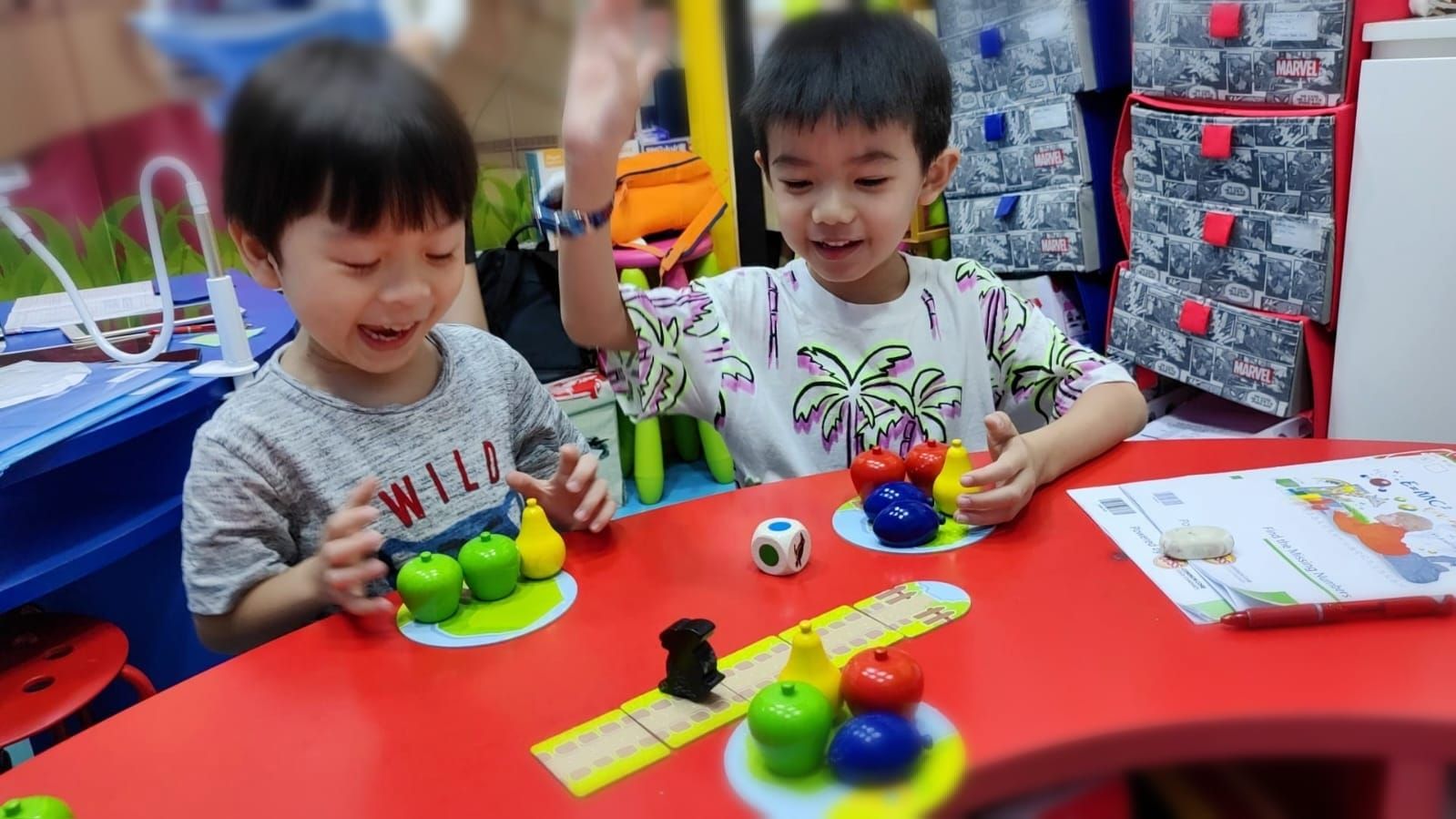
Maths Games Class ( Active Math Player )
- Learn maths through play in an all-English environment (for ages 3–6)
- Move beyond rote drills and introduce innovative math games (PLAY WITH NUMBERS) to truly build children’s math skills. Our activity-based approach lets children learn through play, boosting their interest in learning, communication skills and social confidence.
- LISTEN: Encourage children to listen carefully to the game rules so they can win
- LET'S PLAY: Improve students’ problem-solving speed and response time
- REPORT: Helping students observe and discover the relationship between game rules and winning strategies
3. 🔢 What about 18 + 18? (Two-digit + two-digit | Addition with carrying)
Once children have mastered the methods above, they can take on a further challenge:
18 + 18 = ?
18 can be split into:
10 + 8
Two 18s make:
10 + 8 + 10 + 8
First, keep both 10s in mind:
10 + 10 = 20
Then calculate:
8 + 8 = 16
Finally:
20 + 16 = 36
So:
18 + 18 = 36 🎉
At this stage, children are moving beyond simply counting on their fingers and beginning to understand the relationship between the tens and ones digits.
4. 🎓 Primary One Interviews: The Biggest Mistake Is When Children Only Know How to “Memorise Answers”
When preparing for Primary 1 interviews, many parents want their child to quickly memorise:
1+1, 2+2, 5+3, 8+8……
This kind of practice can help children calculate faster.
But proper preparation for Primary 1 interviews goes beyond simply “memorising answers.”
Because what if the interviewer asks:
8 + 8 = ?
The child answers:
16!
No problem.
But what if the teacher suddenly asks it another way:
❓ + 2 = 9
Would your child know the answer?
The answer is:
7
At this point, the teacher isn’t just checking whether children have memorised “7+2=9”.
Instead:
« Do children really understand the relationships between numbers?»
Olympiad Maths Games Class( English Olympiad Maths )
Olympiad-style problems can help children prepare for a range of maths tests and competitions. Introducing the brand-new Olympic Math Player course: “Olympiad Maths Games.” Many parents ask, “What is Olympiad maths?” It’s a type of maths IQ puzzle that helps children develop their numeracy, spatial awareness, logical thinking and reasoning skills.
- Hong Kong’s only Olympiad maths course written in English, designed to help children tackle challenging questions at school.
- Our introductory maths problem-solving course is designed for students who are ready to challenge themselves. A series of challenging Mathematical Olympiad-style problems helps students develop their analytical, problem-solving and logical reasoning skills.
- Combine different types of mathematical concepts
- Applying maths to everyday life

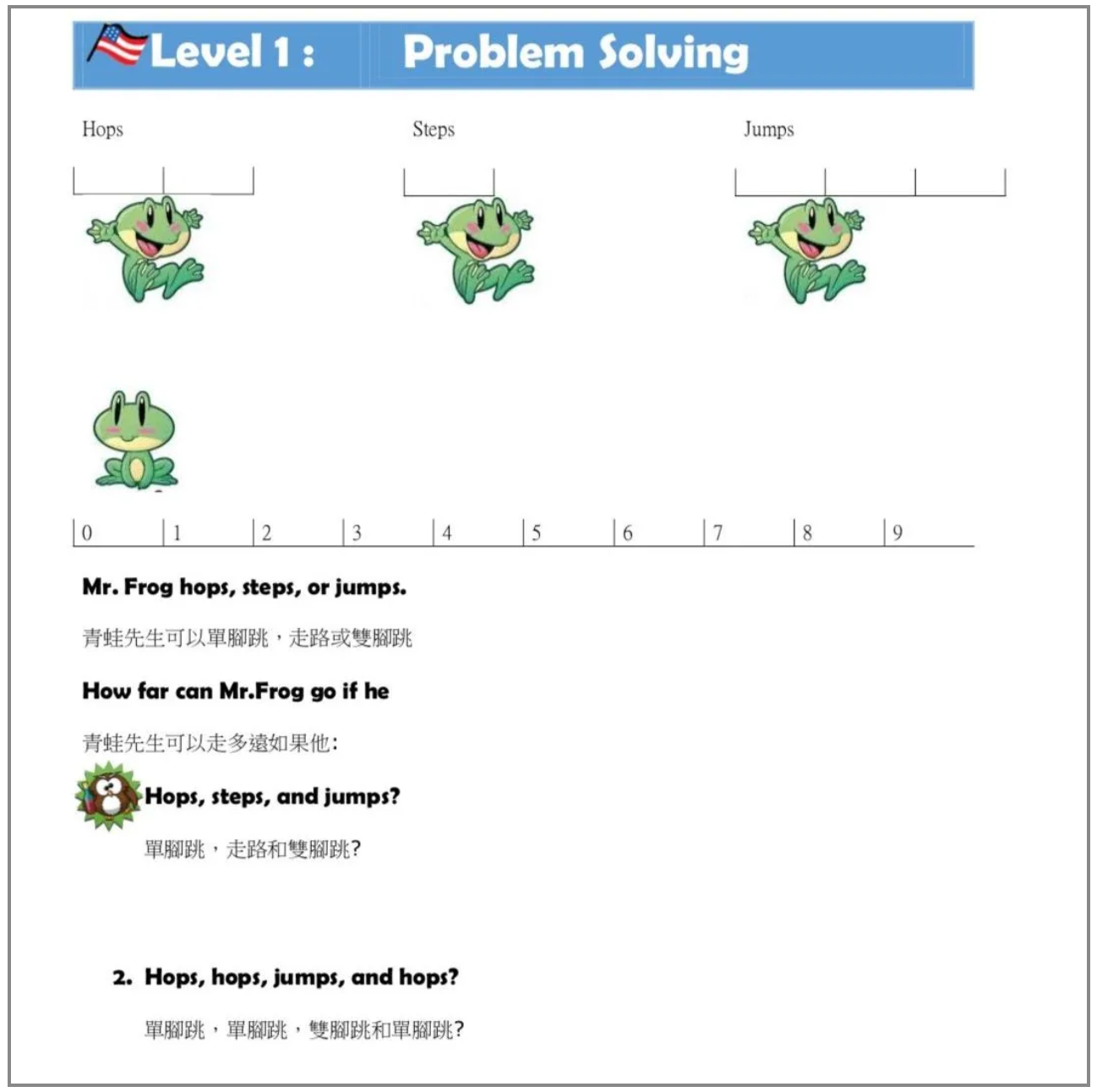
5. 🐸 Primary 1 interview math questions might also be asked like this!
For example:
“Froggy jumps forward 3 steps, hops 2 steps, then takes 1 step. Where does it end up?”
If they’ve only memorised addition facts, children may not understand the question straight away.
But if children know:
3 + 2 + 1 = 6
you can understand:
🐸 Jump = 3
🐸 Hop = 2
🐸 Step = 1
In total:
3 + 2 + 1 = 6
Froggy has moved forward 6 steps altogether.
This type of question tests whether children can connect a real-life situation → quantity → addition.
6. ⏱️ How can you practise the “120-second countdown”?
If you’d like your child to respond more quickly to math questions in Primary 1 interviews, you can add some simple countdown and mental math practice.
For example:
20, 19, 18, 17……
Then gradually increase the difficulty:
20, 18, 16, 14……
Or:
15, 14, 13, 12……
These exercises help children gradually develop a feel for number order and the distance between numbers.
The goal isn’t simply to be “fast,” but to help children gradually develop their own number sense (Number Sense).
7. What is mathematics? What is arithmetic?
Math isn’t just addition, subtraction, multiplication and division. Math is a science. Clearly, neither abacus mental arithmetic nor Kumon is a science! That’s why these are called arithmetic, not mathematics.
If you want to know what mathematics really is, you can read a book called A Mathematician’s Lament.
P.S. Using Montessori math materials is real mathematics. Math Olympiad is real mathematics too.
Reference: Curious Mum
8. ❤️ Addition up to 20 is just the beginning, not the end
PARENT TIP: Math games spark children’s interest in learning and make addition and subtraction easy. So, if you’re simply hoping for your child to:
«“ Help your child learn addition within 20 quickly to prepare for Primary One interviews.”»
So, learning to make ten, break numbers apart and count on your fingers can be a great way to get started.
But if you want your child to build a solid understanding of maths, it’s important to take things a step further:
✅ Number sequences
✅ Understanding quantity
✅ The relationship between addition and subtraction
✅ Number bonds and breaking numbers apart
✅ Make Ten
✅ Tens and ones
✅ Mental arithmetic
✅ Logical reasoning
✅ Real-life word problems
✅ Working backwards from the answer
Because the ideal preparation for Primary One interviews isn’t about having children memorise a large number of answers.
Even if the interviewer:
Change the question, ask it another way, add an extra step, or even turn it around,
Children can still work out the answer on their own.🧠✨
👉 If your child just needs to quickly master addition up to 20, start with this simple finger-counting and making-ten method.
👉 If you’d like your child to develop a stronger understanding of maths and confidently tackle variations on questions from interviewers, they should further develop their number sense, logic and mental maths skills.
Primary One interviews don’t just test whether a child “can do sums”; more importantly, they look at whether the child knows how to “think mathematically.” 🎓🧮
Other Articles:
- What Is Olympiad Maths, and Why Are More Parents Choosing It for Their Children? | Learn About the Benefits, Best Age to Start and Courses
- 🎯 Mental Abacus vs Olympiad Maths vs Maths Games for Young Children | A Parent’s Essential Comparison Guide 🎯Which Maths Class Is Best for Young Children? A Complete Guide to Play-Based Maths Classes (A Must-Read for Parents)
- 【What Is Number Sense?】A Must-Read for Parents | 5 Practical Tips + Number Sense Games to Boost Your Child’s Maths Skills
- 🎯Which Maths Class Is Best for Young Children? A Complete Guide to Play-Based Maths Classes (A Must-Read for Parents)
- What Is English Math? A Complete Guide to Its Benefits, Primary School Questions and Practice Exercises 🧠✏️
- International School Math | Hong Kong’s Only English Olympiad Math | International School Math
- 【Olympiad Maths Questions】Download Free Olympiad Maths Worksheets + Video Explanations | Free Practice for Primary 1, 2, 3 and 5
- 【Parent-Child IQ Puzzles】2026 IQ Puzzles for Kids|IQ Puzzles for Primary School Students + Challenging IQ Puzzles to Get Kids’ Right Brains Working!
- Is Your Child Struggling with Maths? 5 Ways to Build Number Sense and Strengthen the Basics