[Eye Exam Prices 2026] Which Eye Exam Center is Best for Children? Children's Eye Exam Prices | Recommended Children's Eye Exam Centers
Updated: 09/01/2025
Comparison of eye exam fees and procedures at PolyU, opticians, hospitals, and clinics.
Which is the best for children's eye examination? Since the epidemic, the problem of myopia among Hong Kong school children has become increasingly serious. A survey by CUHK shows that the myopia rate among Secondary 3 students is as high as 66%! Children's eye examination is an important test to prevent the progression of myopia. What does children's eye examination test? How to choose between children's eye examination center and children's eye examination government? How much does an eye examination cost for a child? Read the following article to tell you!
The prevalence of myopia in Hong Kong
Hong Kong has one of the world's most serious myopia problems. Among 6-year-old school children, about 18% are nearsighted, and this proportion jumps sharply to about 62% by age 12. The degree of myopia increases with age, and only stabilizes around age 20.
Therefore, the first step in protecting eyesight is to have regular eye exams, especially starting from childhood, to detect vision problems in children as early as possible.
Want to know about the cost of eye exams in Hong Kong? What are the differences in prices and examination items between Polytechnic University, hospitals, clinics, and opticians?
A survey by PolyU and CUHK showed that childhood myopia has worsened significantly.
Children are constantly glued to their phones, from online classes at home during the pandemic to daily gaming, binge-watching TV shows, and using messaging apps. This constant use of phones and tablets is a major contributing factor to the rising myopia rate among school children. A survey conducted last year by the Centre for Educational Data Research at the Chinese University of Hong Kong, involving over 200 local primary and secondary schools and nearly 19,000 students, parents, and teachers, found that the myopia rate was approximately 28% for Primary 3 students, 50% for Primary 6 students, and 66% for Secondary 3 students.
1. Children's Eye Examination (Part 1) ~ Causes of Myopia
Myopia is mainly caused by an elongated eyeball, causing the image to focus in front of the retina, resulting in clear near vision but blurry distant vision. The medical community primarily explains the causes of myopia in two ways: genetics and environment. Prolonged close-range visual activity (such as reading, using a computer, or watching television) can lead to myopia.
2. Children's Eye Examination (Part 2) ~ Causes of Astigmatism
Astigmatism is caused by an uneven curvature of the cornea, preventing light from forming a single focal point and resulting in blurred vision. Astigmatism may coexist with myopia or hyperopia, and the symptom is blurred vision for both near and far objects.
3. Children's Eye Exam (Part 3) ~ Free Government Eye Exam
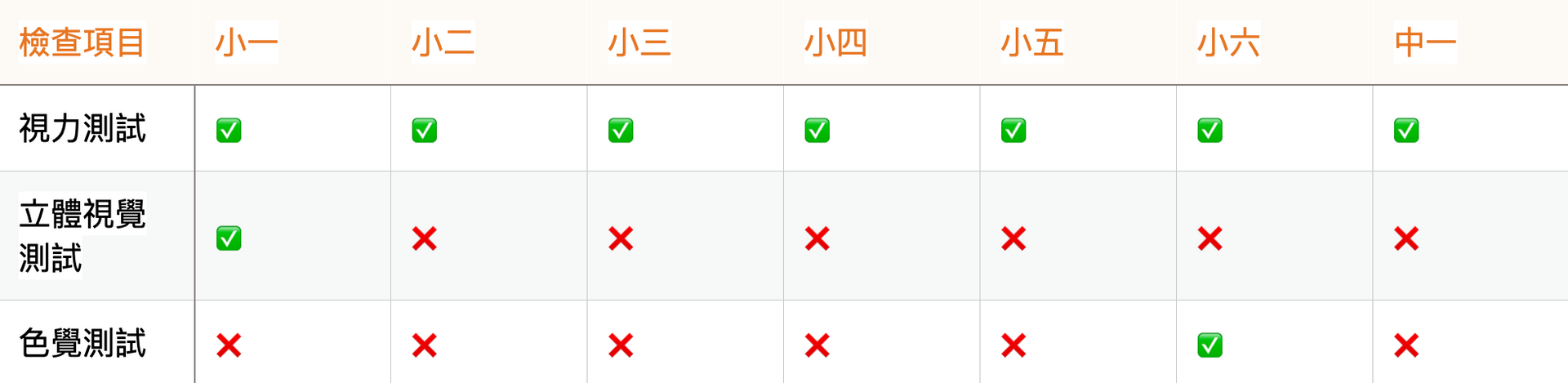
Preschool children aged 4 to 5 can enjoy the "Preschool Children's Vision Screening" service provided by the Department of Health's Family Health Services, which is conducted by a registered optometrist/vision corrector. As for eligible primary and secondary school students, the Department of Health's Student Health Services will provide free annual health check-up services, which include vision tests, stereoscopic vision tests, and color vision tests.
Which room is best for a children's eye exam? What are the prices and discounts for children's eye exams?
There are early signs of worsening myopia in children, such as frequent eye rubbing, easy eye fatigue, looking at electronic screens closer to the eyes, and increasingly blurred vision. Vision testing for children is an effective method to identify the cause of myopia and assess its severity, thereby finding ways to control its progression. Many eye examination programs for children are available, with prices varying considerably. How should parents choose a vision test? Which children's eye examination center is the best?
1. Children's Eye Examination (Part 1) ~ Eye Examination at the University of Science and Technology
The PolyU Eye and Optometry Clinic at Hong Kong Polytechnic University offers a variety of eye examinations, including comprehensive eye and optometry, contact lens care, corneal orthodontics, and glaucoma screening. Those wishing to undergo a comprehensive eye and optometry examination by a registered optometrist and ophthalmologist can book through their online booking system; other examination services require telephone booking.
A comprehensive ophthalmological optometry examination includes:
Visual acuity and refractive examination
Visual function tests (such as binocular coordination, color vision, pupillary response, eye movement, etc.)
Eye health check (intraocular pressure, external and internal eye health examination)
Fee Schedule
Comprehensive eye examination: HK$680
Follow-up inspection: HK$450 to HK$650
Pediatric comprehensive ophthalmological examination: HKD 800
Pediatric follow-up examination: HK$600 to HK$800
2. Children's Eye Examination (Part Two) - Basic Children's Vision Test
Does a child have signs of nearsightedness before needing an eye exam? According to the Department of Health, children should begin undergoing eye exams from the age of four to assess basic vision problems. Optometrists recommend that children start eye exams as early as age two. If a child has potential vision problems, they can be detected and addressed before their vision development is complete, thus controlling myopia early.
3. Children's Eye Examination (Part 3) ~ School Children's Myopia Control Center
Basic vision tests help identify vision problems in schoolchildren and assess their severity. Generally, myopia of 600 degrees or more is considered high myopia, and astigmatism of 250 degrees or more is considered severe astigmatism. Both severe myopia and astigmatism increase the risk of eye diseases such as macular degeneration, glaucoma, retinal detachment, and even blindness. Regardless of the severity of the vision problem, it should be addressed early. The most basic approach is to wear glasses for myopia, hyperopia, or astigmatism, or to have corrective lenses fitted through an eye exam to avoid the inconvenience of wearing glasses.
Eye examination services include:
- Comprehensive ophthalmological examination for school children, including eye drops to dilate the pupil and examine the fundus, strabismus and color blindness tests, etc. - Axial length measurement - Intraocular pressure measurement - Fitting of school glasses and contact lenses - Providing different myopia control solutions, including fitting different myopia control lenses (e.g., DIMS, Stellest).
VISUAL PLUS MYOPIA MANAGEMENT CENTRE, Ma'anshan, Shop A11, Ground Floor
Powered by AME
Other articles:
1. [What is Olympiad Math?] Breaking down 4 reasons why Olympiad Math can make children "outstanding".
2. [Olympiad Math Problems] Free download of Olympiad Math practice problems detailed video explanations (Part 1)
3. Children's math is not good? 5 tricks to help him improve number sense, strengthen the foundation
4. International School Math | Hong Kong's Only English-Language Math Olympiad | International School Math
5. [Olympiad Math Problems] Free download of Olympiad Math practice problems detailed video explanations (Part 2)
6. [What are STEM courses?] 5 major benefits of STEM education
7. [STEM Curriculum] Overview: What is STEM Education? Recommendations for STEM Interest Classes
8. [Extracurricular Classes for Three-Year-Olds] 3 Must-Take Extracurricular Classes Recommended to Prepare You for Future School Admission Interviews
9. [Children's Extracurricular Classes] Five Recommended Children's Extracurricular Classes: The Key to Giving Your Child a Head Start
0. [Parent-Child IQ Quiz] 2026 Children's IQ Quiz: Get Kids' Right Brain Working!